
In July, the Science and Technology group assembled to hear a talk with the intriguing title, “The Nailfile, the Puddle and the Tardigrade” by Jenny Lee, and instead of just sitting back and listening, the group had to fill in their handout and answer questions. This, Jenny said, was with the aim of keeping them awake throughout the talk!
We began by a way of thinking of the age of the earth by stretching out our arms. If the age of the earth - from when it first formed to the present day - is the length of your arm from shoulder to fingertip, our whole human history could be wiped out by the single swipe of a nail file. We then concentrated on what happened during the time between shoulder and wrist- how the new earth formed, developed its atmosphere and later acquired water. We looked at how life may have begun from inorganic molecules, a little under 4 billion years ago, when conditions were just right.
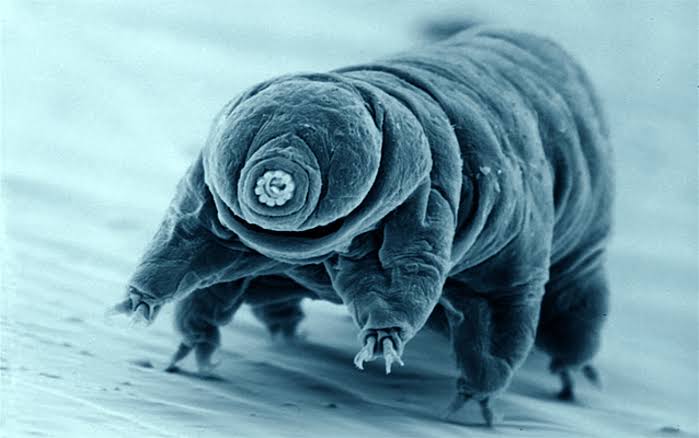
We went on to explore what happened during Snowball Earth, about 715,000,000 years ago. We heard that after about 50 million years, the ice’s grip began to loosen, when dark dust, stripped away by the wind from the highest peaks still protruding above the ice, sucked in the sun’s warmth, and created tiny meltwater puddles. But what really set the thaw going was red hot lava smashing through the ice, absorbing the heat of the sun and releasing volcanic gases…. including carbon dioxide, the greenhouse gas. When the ice finally melted, it flooded millions of tonnes of minerals into the sea, and life began to flourish again. It was still microscopic and it might have included animals such as the .5 of a millimetre tardigrade, descendants of which can still be found thriving at the bottom of seas, in tropical rainforests, at temperatures of -273°C. The talk ended with life emerging from the water and onto the land.
The Amazing Tardigrade
A science quiz followed; although the scoring was arbitrary, and the prize for the best team was only extra biscuits, nobody seemed to mind.
The next talk, in September will be “The Fascinating World of Fungi” by Ray Lee. All are welcome.