
Barnard Castle U3a Science and Technology Group - 13th April 2026
The James Webb Space Telescope was launched on Christmas Day 2021. Designed as a successor to the Hubble Space Telescope, its massive 6.5 m mirror gives it unparalleled capabilities in penetrating the deepest regions of space. A previous talk highlighted the contribution of the University of Durham to this extraordinary multi-national project. This talk will provide an update, reviewing the progress since the launch and commissioning of the instrument.
The instrument’s main focus has been to resolve questions around the evolution of the early universe. We can still view the early universe through observations of very distant galaxies. By virtue of their great distance, light from these objects takes thousands of millions of years to reach us. Hence, with these observations, we are viewing the universe in its infancy. Of course, these objects, whilst they are naturally very faint, they are also highly redshifted. This (Doppler) redshift arises from the fact that these galaxies are receding very rapidly from us – close to the speed of light.
To address these challenges, the James Webb Space Telescope has a large 6.6 m mirror – larger than the famous Palomar Telescope, formerly the largest telescope in the world. Most importantly, because the observed light is highly redshifted, the telescope must work in the infrared, not the visible. All instruments on JWST, cameras, spectrometers and imaging spectrometers, must therefore work in the infra-red. Imaging spectrometers, such as the NIRSPEC IFU, enable a spectrum to be acquired and spatially mapped across an extended object, such as a galaxy. Durham University played a key role in the production and testing of this instrument.
Recent JWST observations of distant galaxies have revealed them to be more massive and bright than current cosmological models might suggest. It has thrown into some doubt the role of dark matter in the Universe. A lively cosmological debate has ensued with the promotion of alternative cosmological models. However, the debate continues and no consensus has yet been reached.
Closer to home, JWST has produced the first direct images of exoplanets. Some 6,000 exoplanets (planets outside our solar system), have been discovered, mostly through indirect observations by terrestrial instruments. Within our own solar system, JWST spectrometers have revealed interesting details of the atmospheric chemistry of the Gas Giants and their moons. With the NIRSPEC IFU, this chemistry has been spatially mapped. Most importantly of all, JWST has produced a plethora of stunning images, highlighting the wonderful beauty of our heavens.
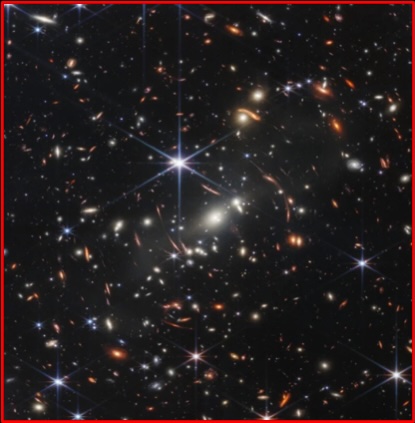
JWST – Deepfield View of Distant Galaxies (Courtesy National Aeronautical and Space Administration)