
Ahead of the British Museum exhibition, we looked at this unique work from three different angles. An antiquarian bookseller, Tom Ayling, usefully set out the historical context by telling the dramatic story of how it could easily have been lost several times over the last 900 years. It was only when French antiquarians in the 18th century began to study and publish drawings of the tapestry that it began to emerge from the neglect of centuries. It was nearly destroyed during the Revolution, but as the 19th century progressed scholarly studies began to accumulate. The London Society of Antiquaries played an important role in bringing it to a wider public by commissioning their artist Charles Stothard, in 1816, to make detailed watercolours of every scene, which were then engraved for publication. His version was so accurate that it was still being used as a reference until well into the 20th century. Finally, with the arrival of colour photography, it could at last be reproduced in print for mass publication.
Second, Professor Michael Lewis, Head of Portable Antiquities at the BM, whose work over many years was crucial in bringing the exhibition to fruition, and Dr Emily Ward, gave us an authoritative overview of the tapestry – who commissioned it, where, how and by whom it was made (though there are no final answers to this), and a scene-by-scene introduction to the narrative and the political significance of each episode.
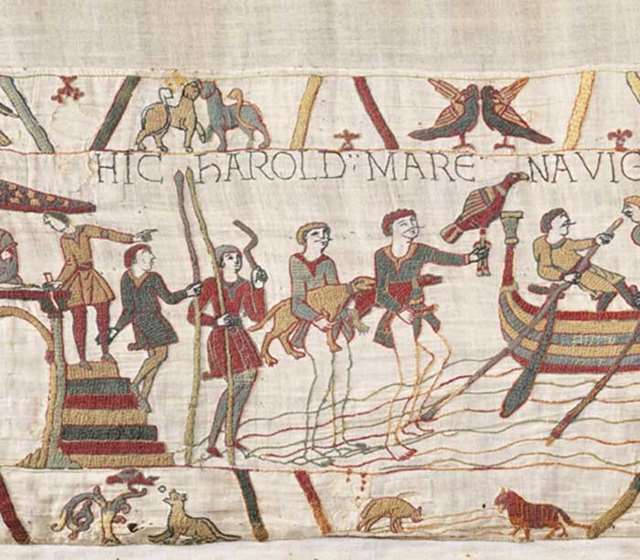
Harold (with hawk) sets out on his expedition to Brittany.
It is noteworthy that Harold is portrayed as noble and courageous, for example when he carries a man on his back through the treacherous quicksands below Mont St Michel.
Finally, a young American scholar took us through the Latin narrative that is embroidered along the top border. This identifies the main characters in each scene and gives a simple explanation of what is happening, much like the running narrative in early comic books. The language is rough-and-ready medieval, not classical, Latin, and is full of fascinating clues as to the linguistic background of the makers. These clearly show influences from Old English (Anglo-Saxon) and Norman French which distort the Latin text.
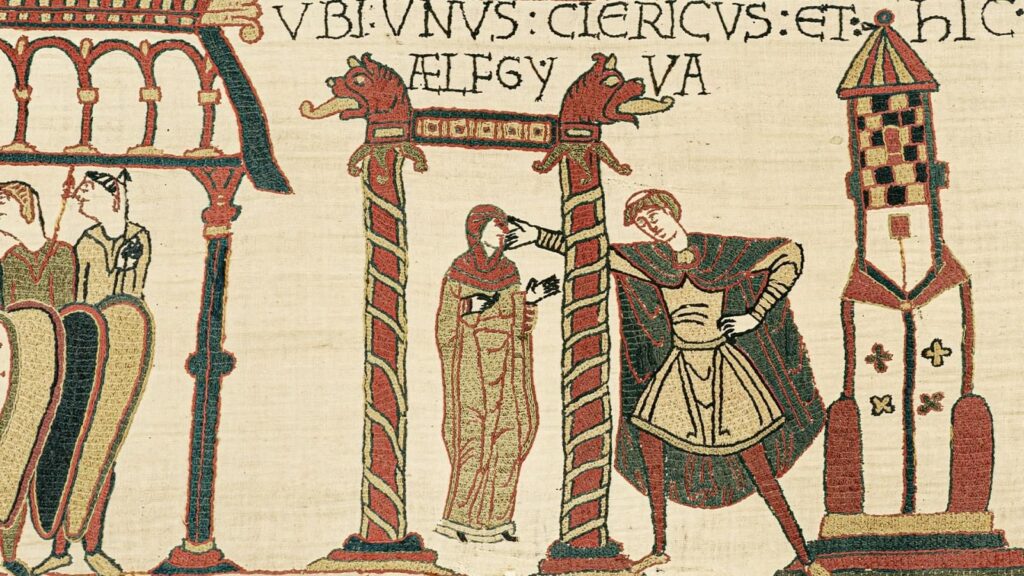
What is going on here between the priest and ᴁLFGYVA? Nobody knows.
One obvious example is the use of the Old English letter ᴁ, another the spelling of William’s name as ‘WILGELMUM’ where the ‘G’ reflects Old English usage, standing for the ’y’ sound which would be written as ‘I’ in Latin.
The October meeting will be a ‘show and tell’ session, where members are invited to bring along a favourite artefact and say what it means to them.
Report by Tony Seward