
August 2026 field trip to Bolton-on-Swale Lake and Scorton Lakes
After the recent July heatwave it was a relief that our August trip enjoyed a pleasant warm and dry visit to these former gravel pits near Catterick. Thirteen of us met at the Yorkshire Wildlife Trust lake near Bolton-on-Swale which has a small hide and larger viewing screen. This summer up to six Black-crowned Night Herons* had been seen using the large Willow trees as a roost and we hoped to see them. These small migratory herons do mainly feed at night, so we would have to be lucky to see them during daylight hours; needless to say we did not have that luck!
Despite the herons not showing we did see a good number of species, including (for some) a Kingfisher, some large flocks of Tufted Duck, Mute Swans, and a rare Red-crested Pochard (female). Along the hedgerow between the hides were large number of warblers actively feeding in preparation for their migrations south, and Lapwings and Curlews were in good numbers on the opposite fields. In the owl nest box at the base of the Osprey platform we could occasionally see the resident Barn Owl as it peered out.
After a short stop at the local cafe we then went on to the nearby Scorton Lakes area. At the first lake we were entertained by the Great-crested Grebes; one of this year’s humbug-striped chicks was constantly begging its parent for food and we eventually saw it receiving several small fish caught by the parent bird. En route to the next lake we watched a Sparrowhawk being mobbed by a gull, Buzzards, and in the opposite direction 3 Jays made brief appearances.
From the viewing areas over the next lake we had extensive views of large flocks of birds; quite a spectacle. In addition to the Greylag and Canada geese flocks there was a large flock of the smaller Barnacle Geese that are a resident feature of the Scorton area. Little Egrets were outnumbered by Great White Egrets and it was nice to compare their sizes. Overhead we had good numbers of Sand Martins and Swallows. At this time of the year many wader species that breed in more northerly latitudes stop off in the UK to feed and put on weight for their long migration to southern Europe and Africa. Sure enough, we found 3 very active Ruff, a Green Sandpiper and a Common Sandpiper. Three Snipe gave good views and while we were watching these Jim found 2 Yellow Wagtails (we double-checked these were not the more local Grey Wagtails we see on the Tees and its becks; Greys have yellow bellies too and many people can mistake the two species).
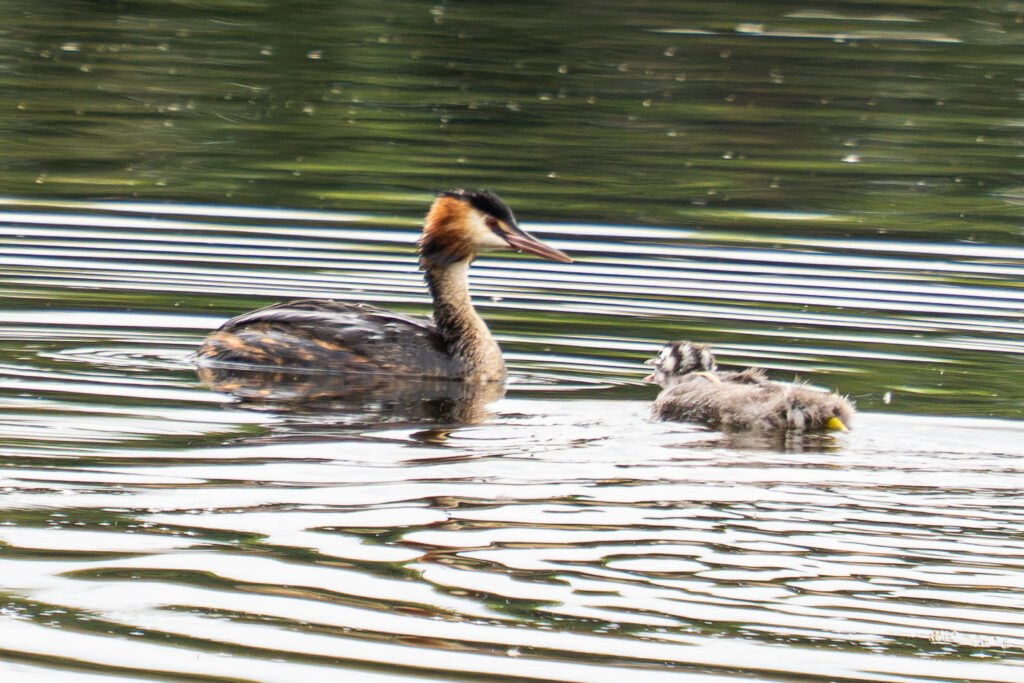
Great-crested Grebe and chick at Scorton Lakes; photo by Anne Newton.
Nearly 40 species were seen at these local sites. Scorton Lakes is a fantastic local nature site and public amenity. It’s future is currently under threat by a proposed luxury lakeside housing development. There is an active group trying to prevent the loss of this amenity that needs as many people as possible to object to the proposed development:
* The Black-crowned Night Herons at the lake were featured on BBC News.
Report by Andrew Lapworth