
Henri Matisse (1869-1954)
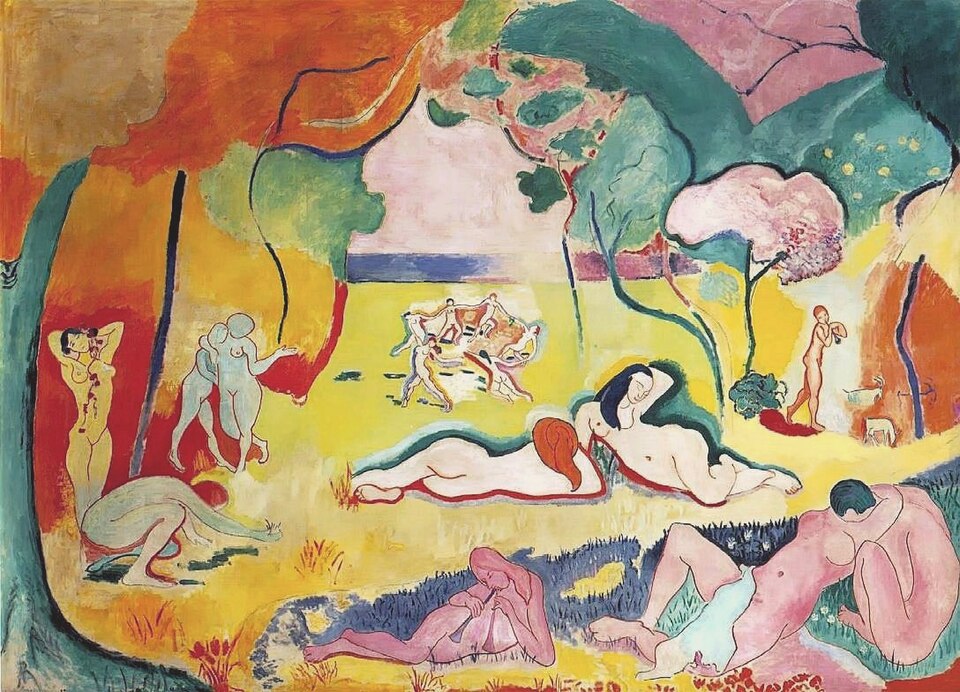
In his long career, Matisse early established himself as one of the leading figures in contemporary art. In friendly rivalry with Picasso, he constantly pushed the boundaries, experimenting boldly with colour, form and technique. We began our July session with one of Professor Kloss’s masterly short introductions, explaining the significance of Matisse’s early breakthrough with the painting Le Bonheur de Vivre, with its strange forms and Fauvist colours – a modernist vision of Arcadia.
Le Bonheur de Vivre,1905-6, (The Barnes Foundation, Philadelphia)
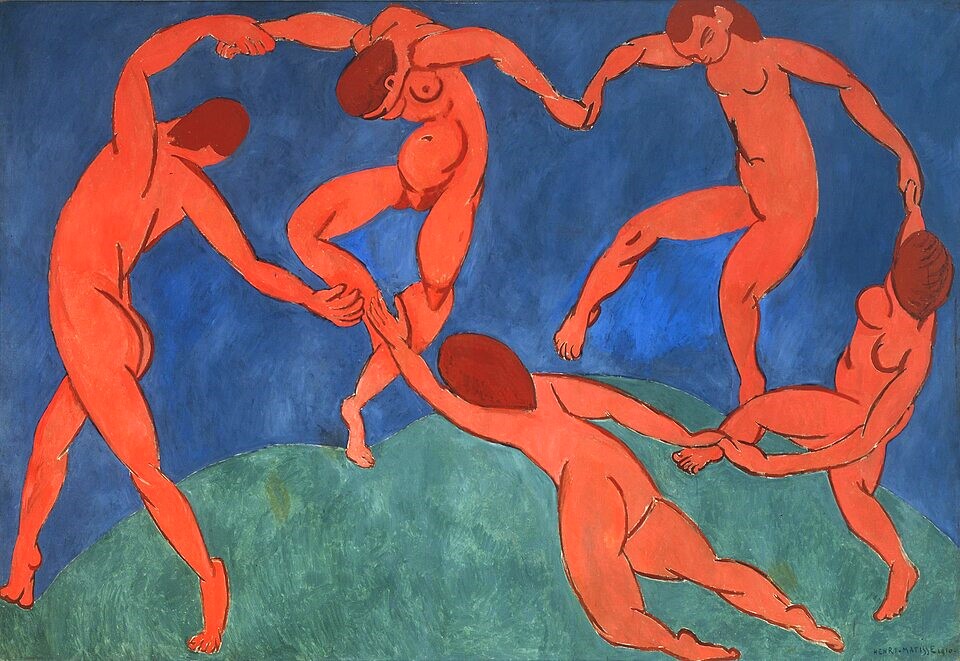
An engaging Irishman then took us through Matisse’s life and work, from his childhood in industrial Northern France and training in Paris, to his formative collaboration with the Fauves (who included Braque and Derain), and development of the avant-garde compositions which so appealed to the Russian collector Sergey Shchukin that he bought 38 of them. While these were available for the last great Matisse retrospective in 1996, they can unfortunately no longer be shown in the West as they remain in Russia.
La Danse II, 1910, (Hermitage Museum, St Petersburg)
With the coming of World War One, some critics argue that Matisse reverted to a more comfortable, immediately appealing style, with his move to Nice and travels to Morocco and Algeria. He was still experimenting, moving gradually towards abstraction, but the paintings of this period are of exotic colourful landscapes and people. The rich blues, later taken up by Yves St Laurent, are characteristic of this period.
Between the wars he continued to pare down his style, ever striving for greater purity, economy and balance, until a serious operation in 1941 forced him to invent an entirely new way of artmaking – the famous paper cut-outs. It was almost as if his illness had helped him to crown his life’s work with these exercises in pure form, colour and movement. A well-known example is The Snail in Tate Modern.
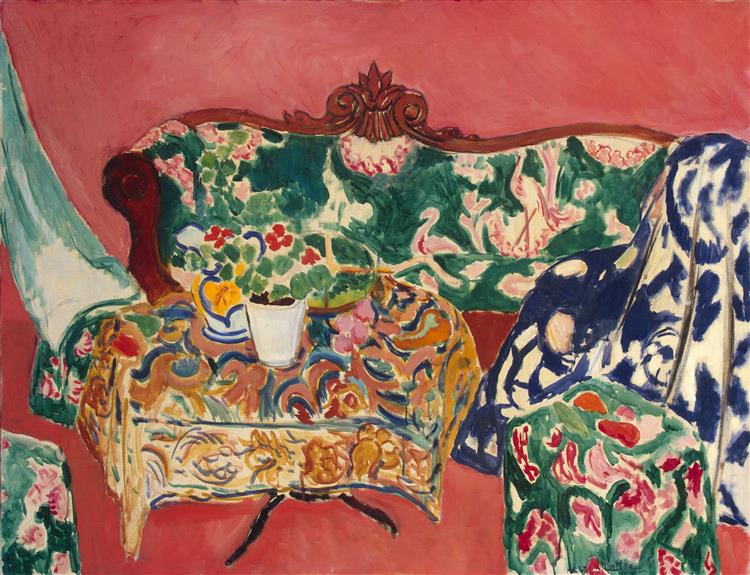
From his early days growing up in a major textile-producing area, Matisse had always found inspiration in the colours and patterns of fabrics. We concluded with a blog showing how, as he travelled farther afield, he was able to incorporate fabric and embroidery designs from different cultures including Spain, Moorish North Africa, even Polynesia. These in turn were adopted by leading fashion houses, and continue to be influential to this day
Seville Still Life, 1910, (Hermitage Museum, St Petersburg)
Next month, Wed 2 September: The Bayeux Tapestry
Report by Tony Seward.