
To mark the current exhibition of his work at the National Gallery, our April session was devoted to Joseph Wright of Derby (1734-97). Many will be familiar with his two most famous paintings, An Experiment on a Bird in the Air Pump and A Philosopher Lecturing on the Orrery, but it was rewarding to have a closer look and explore them in all their complexity.
Wright’s career followed a fairly typical trajectory for artists at the time, training in London, visiting Italy in the wake of the Grand Tourists, and making his living primarily by portraiture. He was proud to be a provincial artist, and based himself mainly in Derby, where there was a ready market amongst the rising entrepreneurs of the region, as well as the aristocracy and local gentry. He may have been a member of the Lunar Society, and certainly knew many of its members, who included Midland luminaries such as Josiah Wedgwood, Erasmus Darwin and Matthew Boulton. He was thus familiar with the exciting contemporary advances in science, technology and industry.
However, his response to these was strongly influenced by his artistic training. Following the revolution in treatment of chiaroscuro initiated by Caravaggio, many European painters came to focus on scenes lit by candlelight or moonlight, giving ample opportunity for dramatic contrasts of light and shade. Wright was the leading English artist of this so-called tenebrist school. In ‘conversation pieces’ like the Air Pump he combined candlelight with his proficiency in portraiture to brilliant effect. There is drama and pathos in the scene, as well as a fascination with science and technology. Even at the time, the use of live animals in such experiments was regarded as inhumane, especially as they were not at the cutting edge of scientific research, but were often put on by travelling showmen for the entertainment of the public. The varying reactions of the characters in the painting reflect this ambiguity.
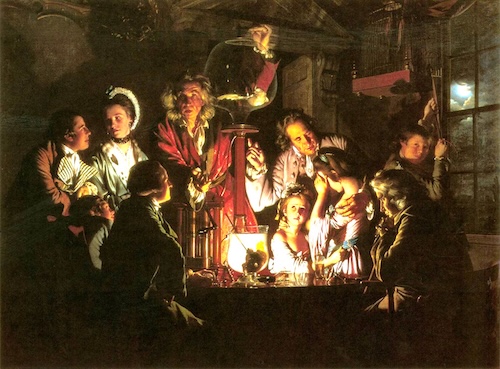
An Experiment on a Bird in the Air Pump, 1768 (National Gallery, London)
If you can’t visit the exhibition, which closes on 10 May, it is well worth a detour to Derby next time you are on your way south. Derby Museum and Art Gallery has the most comprehensive collection of Wright’s work in existence, including the Orrery and landscapes of the nearby Peak District.
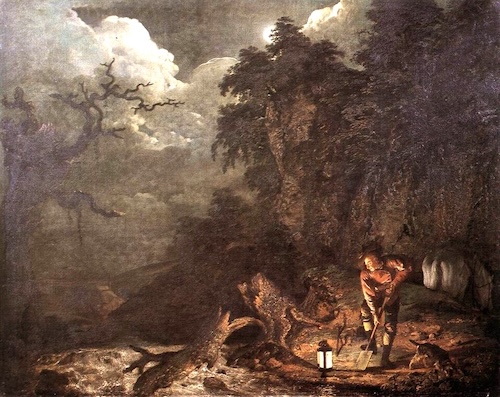
An Earthstopper on the Banks of the Derwent, 1773 (Derby Museum and Art Gallery).
An earthstopper’s job was to block up foxholes to prevent the foxes from going to earth during a hunt.
Report by Tony Seward